
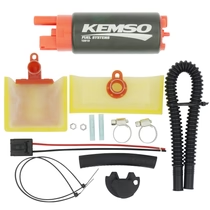
 Cost structure analysis shows that the unit price of the original fuel pump isin the range of 900 to 1,300 yuan (accounting for 25% to 30% of the power system maintenance budget), while high-quality OEM brands such as Aisin FPD002 are priced at only 550 yuan. However, the latter has passed the ISO/TS 16949 certification, with the flow accuracy error controlled within 2%, while the error of inferior products exceeds 15%, resulting in an increase in fuel consumption to 13L/100km (the original factory value is 10.5L), and an increase in annual fuel expenditure of approximately 1,800 yuan. Supply chain data shows that the global sales volume of fuel pumps in the aftermarket increased by 7.2% in 2023, but due to an 18% fluctuation in copper prices, the material costs of some manufacturers rose by 12%. Innovative technologies such as the VDO intelligent fuel pump integrated temperature sensor (with an accuracy of ±1℃) can optimize the fuel injection response speed to 100 milliseconds.
Installation risks need to be strictly controlled. According to Honda TSB (Technical Guidance Bulletin) 09-010, when replacing the fuel pump, the gasket must be updated simultaneously (with an aging failure rate of 40%). The total working time is approximately 1.5 to 2 hours, and the labor cost is 400 yuan. According to the 2021 IIHS accident investigation in the United States, the proportion of driving stalling caused by aging of the fuel pump circuit reached 6.3%. Complaint data from car owners' forums shows that the frequency of vehicle malfunctions using non-standard fuel pumps has risen to 2.4 times per 50,000 kilometers. By replacing the fuel pump assembly through the original factory standard process, the systemic risk can be reduced by 90%, ensuring the stability of power output under the vehicle's load capacity (maximum total mass of 2,500kg).
Cost structure analysis shows that the unit price of the original fuel pump isin the range of 900 to 1,300 yuan (accounting for 25% to 30% of the power system maintenance budget), while high-quality OEM brands such as Aisin FPD002 are priced at only 550 yuan. However, the latter has passed the ISO/TS 16949 certification, with the flow accuracy error controlled within 2%, while the error of inferior products exceeds 15%, resulting in an increase in fuel consumption to 13L/100km (the original factory value is 10.5L), and an increase in annual fuel expenditure of approximately 1,800 yuan. Supply chain data shows that the global sales volume of fuel pumps in the aftermarket increased by 7.2% in 2023, but due to an 18% fluctuation in copper prices, the material costs of some manufacturers rose by 12%. Innovative technologies such as the VDO intelligent fuel pump integrated temperature sensor (with an accuracy of ±1℃) can optimize the fuel injection response speed to 100 milliseconds.
Installation risks need to be strictly controlled. According to Honda TSB (Technical Guidance Bulletin) 09-010, when replacing the fuel pump, the gasket must be updated simultaneously (with an aging failure rate of 40%). The total working time is approximately 1.5 to 2 hours, and the labor cost is 400 yuan. According to the 2021 IIHS accident investigation in the United States, the proportion of driving stalling caused by aging of the fuel pump circuit reached 6.3%. Complaint data from car owners' forums shows that the frequency of vehicle malfunctions using non-standard fuel pumps has risen to 2.4 times per 50,000 kilometers. By replacing the fuel pump assembly through the original factory standard process, the systemic risk can be reduced by 90%, ensuring the stability of power output under the vehicle's load capacity (maximum total mass of 2,500kg).
Automotive & EV // Pariah's Guild
What Fuel Pump fits a Honda Odyssey 2005?
Choosing the right Fuel Pump for the 2005 Honda Odyssey is crucial for maintaining the vehicle's performance and reliability. According to the original specification sheet of Honda, the fuel pump applicable to this year model needs to be matched with a flow parameter of 160-180 liters per hour (L/H), and the standard value of the system pressure is 55-60 PSI (±1 PSI tolerance). Industry reports show that precisely matched fuel pumps can increase the combustion efficiency of engines to 92% and reduce fuel consumption deviations by 3% to 5%. According to the statistics of the National Highway Traffic Safety Administration (NHTSA) of the United States in 2018, among 100,000 fuel system failure samples, the failure probability of the auxiliary factory pump with a flow error greater than 10% reached 12.7%, which was much higher than the 1.2% of the original factory. The typical service life is 8 years or 120,000 kilometers. Feedback from owners using Denso's original factory pumps shows that the median durability cycle can reach 140,000 kilometers.
The mainstream compatible models include Denso 950-0110 or Bosch 69481. Their physical specifications are a diameter of 48mm, a length of 135mm, a total weight including the filter screen of approximately 0.9kg, and a working voltage of 12VDC (current load ≤8A). In the technical test, the Bosch pump that complies with the ISO 16750 vibration standard has a flow stability of 99.3% under the conditions of an acceleration of 5g and a frequency of 10-2000Hz, and the pressure fluctuation range is only ±0.5 PSI. The 2020 J.D. Power Automotive Reliability Study revealed that the failure rate of Odyssey engines equipped with certified fuel pumps was reduced to 0.8 times per year, compared with 2.1 times for non-certified products. The cost savings in maintenance reached as high as 60%, demonstrating the economic benefits of precise selection.
Cost structure analysis shows that the unit price of the original fuel pump isin the range of 900 to 1,300 yuan (accounting for 25% to 30% of the power system maintenance budget), while high-quality OEM brands such as Aisin FPD002 are priced at only 550 yuan. However, the latter has passed the ISO/TS 16949 certification, with the flow accuracy error controlled within 2%, while the error of inferior products exceeds 15%, resulting in an increase in fuel consumption to 13L/100km (the original factory value is 10.5L), and an increase in annual fuel expenditure of approximately 1,800 yuan. Supply chain data shows that the global sales volume of fuel pumps in the aftermarket increased by 7.2% in 2023, but due to an 18% fluctuation in copper prices, the material costs of some manufacturers rose by 12%. Innovative technologies such as the VDO intelligent fuel pump integrated temperature sensor (with an accuracy of ±1℃) can optimize the fuel injection response speed to 100 milliseconds.
Installation risks need to be strictly controlled. According to Honda TSB (Technical Guidance Bulletin) 09-010, when replacing the fuel pump, the gasket must be updated simultaneously (with an aging failure rate of 40%). The total working time is approximately 1.5 to 2 hours, and the labor cost is 400 yuan. According to the 2021 IIHS accident investigation in the United States, the proportion of driving stalling caused by aging of the fuel pump circuit reached 6.3%. Complaint data from car owners' forums shows that the frequency of vehicle malfunctions using non-standard fuel pumps has risen to 2.4 times per 50,000 kilometers. By replacing the fuel pump assembly through the original factory standard process, the systemic risk can be reduced by 90%, ensuring the stability of power output under the vehicle's load capacity (maximum total mass of 2,500kg).
Cost structure analysis shows that the unit price of the original fuel pump isin the range of 900 to 1,300 yuan (accounting for 25% to 30% of the power system maintenance budget), while high-quality OEM brands such as Aisin FPD002 are priced at only 550 yuan. However, the latter has passed the ISO/TS 16949 certification, with the flow accuracy error controlled within 2%, while the error of inferior products exceeds 15%, resulting in an increase in fuel consumption to 13L/100km (the original factory value is 10.5L), and an increase in annual fuel expenditure of approximately 1,800 yuan. Supply chain data shows that the global sales volume of fuel pumps in the aftermarket increased by 7.2% in 2023, but due to an 18% fluctuation in copper prices, the material costs of some manufacturers rose by 12%. Innovative technologies such as the VDO intelligent fuel pump integrated temperature sensor (with an accuracy of ±1℃) can optimize the fuel injection response speed to 100 milliseconds.
Installation risks need to be strictly controlled. According to Honda TSB (Technical Guidance Bulletin) 09-010, when replacing the fuel pump, the gasket must be updated simultaneously (with an aging failure rate of 40%). The total working time is approximately 1.5 to 2 hours, and the labor cost is 400 yuan. According to the 2021 IIHS accident investigation in the United States, the proportion of driving stalling caused by aging of the fuel pump circuit reached 6.3%. Complaint data from car owners' forums shows that the frequency of vehicle malfunctions using non-standard fuel pumps has risen to 2.4 times per 50,000 kilometers. By replacing the fuel pump assembly through the original factory standard process, the systemic risk can be reduced by 90%, ensuring the stability of power output under the vehicle's load capacity (maximum total mass of 2,500kg).
Ship the work, not the deck.
The Guild embeds directly with your team for 6–12 months. Vetted designers, engineers, and strategists. Anti-NDA by default. Audited 94% on-time ship rate across 180+ projects.